

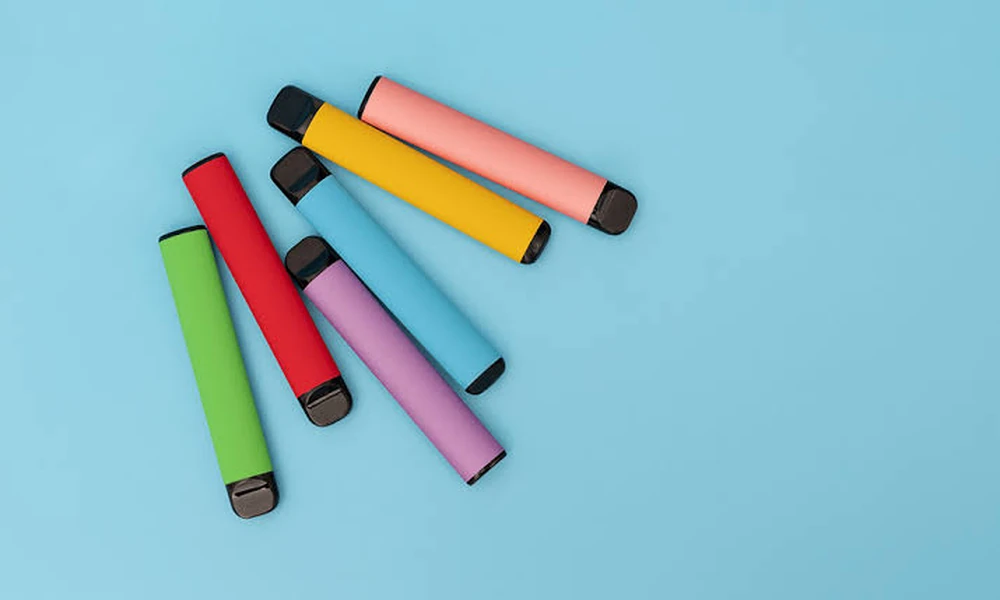
Rechargeable disposable vapes carry a USB charging port that restores battery charge during use, while fully disposable devices run on a sealed non-rechargeable cell that reaches a fixed endpoint when charge depletes. Both formats use sealed prefilled liquid supplies and draw activation, but battery behaviour across the working life of each device separates the two formats in practical daily use. Rechargeable Disposable Vapes extend usable life beyond the single charge cycle that defines the fully disposable format, allowing battery and liquid to be managed as two independent resources rather than one combined endpoint.
Battery behaviour across use
Fully disposable batteries are non-rechargeable cells sized to approximate the liquid volume inside the device. Once the charge depletes, the cell has no mechanism for restoring stored energy, and the device reaches its endpoint regardless of how much liquid remains inside. Cell sizing in a fully disposable device aims to match battery life to liquid life, but draw length, frequency, and temperature all affect how closely the two resources actually align during real use.
Rechargeable disposable batteries accept charge input through a USB port at any point during the device’s lifespan. Users who notice a charge dropping during the day can connect to a USB source and restore capacity before the device stops producing vapour. This capability changes the relationship between battery and liquid from a fixed combined endpoint into two separate resources, each managed on its own schedule.
Liquid supply management
Liquid supply in both formats arrives sealed inside the device from the manufacturer. Neither format involves user handling of e-liquid at any stage of normal use. Draw activation pulls vapour through the sealed system without exposing liquid to the user during operation.
Where the formats differ is in how liquid depletion relates to device replacement. In a fully disposable device, liquid depletion and battery depletion together determine when the device gets discarded. In a rechargeable disposable, liquid depletion alone determines the endpoint because battery charge can be restored whenever it drops. A rechargeable disposable device stays in use until the liquid runs out completely, with the battery recharged as many times as needed to reach that point.
Physical format similarities
External construction across both formats shares the same sealed casing style. No removable pod, no refillable section, and no user-accessible internal components exist in either format beyond the USB charging port on the rechargeable variant. Device body dimensions stay compact across both, suited to pocket carry and daily use without additional accessories.
Draw activation is consistent across both formats. Inhale through the mouthpiece, and the sensor triggers current delivery to the heating element. Set the device down, and the circuit opens immediately. Neither format requires a power button, a lock sequence, or any setting adjustment during normal daily use. Handling both devices feels identical from the outside, with the only operational difference being the ability to restore battery charge on the rechargeable variant.
Battery rechargeability is the single operational distinction that separates daily use of one format from the other, and that distinction becomes more relevant the more frequently a user draws across a standard day.