

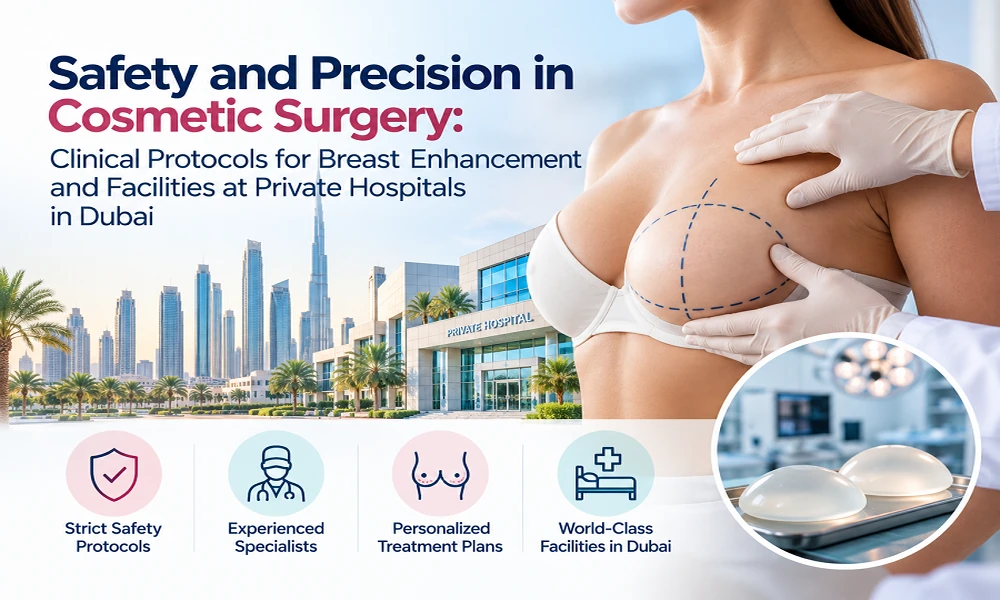
Cosmetic surgery has evolved from purely aesthetic modifications to highly sophisticated, evidence-based surgical interventions. Among aesthetic procedures, breast enhancement encompassing breast augmentationin duba i, mastopexy (breast lift), and composite fat grafting-remains one of the most frequently performed procedures worldwide. However, achieving natural-looking visual harmony, functional longevity, and low revision rates requires far more than artistic skill alone. It demands rigorous clinical protocols, meticulous preoperative planning, advanced intraoperative precision, and adherence to strict institutional safety standards.
As a global destination for specialized medical care, Dubai maintains stringent regulatory oversight governed by the Dubai Health Authority (DHA) and international accreditation bodies. Examining the clinical frameworks governing breast enhancement and the infrastructure offered across private hospitals in dubai reveals how modern surgical science prioritizes patient safety and procedural accuracy.
Preoperative Risk Stratification and Anatomical Planning
The foundation of a safe, successful breast enhancement procedure lies in the preoperative evaluation. Comprehensive risk stratification ensures that patients are medically cleared for elective general anesthesia and that surgical plans are tailored specifically to their anatomical baselines.
1. Medical Clearance and Diagnostic Screening
Prior to scheduling surgery, patients undergo a thorough health assessment. This includes:
- Hematological and Biochemical Panels: Complete blood counts, coagulation profiles, metabolic panels, and viral screenings to rule out occult systemic conditions, anemia, or clotting disorders.
- Pre-Anesthesia Consultation: A comprehensive evaluation by a board-certified anesthesiologist to assign an American Society of Anesthesiologists (ASA) physical status score and formulate a personalized airway and anesthetic management plan.
- Radiological Breast Imaging: Diagnostic mammography or high-resolution breast ultrasound to establish a healthy baseline of parenchyma, rule out undetected lesions, and screen for occult pathologies prior to tissue disruption.
2. Tissue-Based Dimensional Planning
Modern plastic surgery has largely abandoned subjective volume selection in favor of tissue-based surgical planning. Using precise anthropometric measurements-including chest wall diameter, existing soft tissue envelope thickness, parenchymal elasticity, inter-mammary distance, and sternal-notch-to-nipple distance-surgeons calculate the exact dimensional parameters that the host tissue can safely accommodate. Respecting these anatomical boundaries drastically lowers long-term complications such as tissue thinning, traction ripples, symmastia, or bottoming-out deformities.
Surgical Precision: Techniques and Implant Dynamics
Selecting the appropriate surgical pocket, incision site, and implant technology directly dictates both the immediate safety profile and the long-term structural stability of the result.
1. Incision Portals and Surgical Access
Incision sites are strategically chosen to minimize visible scarring while providing optimal visualization for precise dissection:
- Inframammary Fold: Placed in the natural crease under the breast, offering direct visualization of the pectoral fold, maximum control over internal pocket creation, and excellent scar concealment.
- Periareolar: Positioned along the lower semicircular border of the areola, useful when combining augmentation with mild lift procedures, provided the areolar diameter is sufficient.
- Transaxillary: Located within an underarm fold, eliminating scarring on the breast tissue itself and utilizing endoscopic assistance for pocket dissection.
2. Anatomical Pocket Placement
Implants or fat grafts can be placed in different anatomical planes depending on soft tissue coverage:
- Subglandular (Pre-Pectoral): Positioned directly beneath the native breast tissue and over the pectoralis major muscle. This approach is suitable for patients with adequate natural parenchymal coverage.
- Submuscular / Dual-Plane: Positioned partially behind the pectoralis major muscle. The dual-plane approach liberates the inferior origin of the pectoral muscle, allowing the lower pole of the implant to be covered by breast gland while the upper pole remains padded by muscle. This significantly reduces implant visibility, softens the upper transition zone, and lowers capsular contracture rates.
3. Advanced Infection Control: The Minimal Touch Technique
Bacterial contamination-particularly by low-virulence organisms such as Staphylococcus epidermidis-is the primary driver of subclinical biofilm formation, which can lead to capsular contracture. To prevent pathogen introduction, surgical protocols enforce strict sterile measures:
- Use of no-touch insertion funnels to transfer implants directly into the prepared pocket without touching cutaneous edges.
- Triple-antibiotic or antiseptic pocket irrigation prior to device placement.
- Meticulous electrocautery hemostasis to prevent hematoma formation, which otherwise serves as a culture medium for bacterial growth.
- Layered, tension-free closure using absorbable monofilament sutures and specialized topical skin adhesives.
Institutional Safety Metrics at Private Hospitals in Dubai
The quality of the surgical facility is just as critical as the surgeon’s clinical skill. Private healthcare infrastructure in the region adheres to stringent international quality metrics to minimize surgical risk and maintain high standards of patient care.
Key facility parameters include:
1. International Accreditation Standards
Leading private surgical centers hold accreditations from rigorous international bodies such as Joint Commission International (JCI). These certifications mandate standardized infection control protocols, safe surgical checklists (derived from World Health Organization guidelines), medication safety verification, and continuous quality monitoring.
2. State-of-the-Art Operating Theatre Infrastructure
Elective cosmetic procedures require ultra-clean environments. Premier facilities feature:
- Positive-Pressure Laminar Airflow Systems: Specialized ventilation that continuously filters theater air through High-Efficiency Particulate Air (HEPA) units, keeping microbial counts exceptionally low.
- Advanced Monitoring Technology: Continuous intraoperative capnography, invasive arterial monitoring capabilities, and temperature management devices (such as forced-air warming blankets) to prevent hypothermia-induced coagulopathies.
- Dedicated Recovery Suites: Post-Anesthesia Care Units (PACU) equipped for continuous monitoring during phase-one recovery from general anesthesia.
3. Emergency Preparedness and Multidisciplinary Backing
While elective aesthetic procedures have low complication rates, robust medical facilities are prepared for rare medical emergencies, such as malignant hyperthermia, anaphylaxis, or acute respiratory distress. Top private hospitals maintain fully stocked emergency resuscitation carts, 24/7 access to blood bank supplies, on-site intensive care units (ICU), and immediate access to multidisciplinary medical specialists.
Postoperative Rehabilitation and Longitudinal Follow-Up
The clinical care cycle extends well beyond the operating room. Structured postoperative protocols safeguard aesthetic results and ensure early detection of potential recovery issues.
- Immediate Phase (Days 1-7): Pain control utilizing multimodal, non-opioid analgesic regimens, application of medical-grade surgical compression bras to control edema and stabilize implant position, and early mobilization to reduce deep vein thrombosis (DVT) risks.
- Intermediate Phase (Weeks 2-6): Gradual resumption of light daily activities while avoiding strenuous upper-body physical exertion that could disrupt pectoral muscle healing.
- Long-Term Monitoring: Scheduled clinical follow-ups at 1, 3, 6, and 12 months to evaluate soft tissue settling, scar maturation, and implant integration. High-resolution ultrasound or MRI screenings are periodically recommended in subsequent years to verify long-term structural integrity.
Conclusion
Achieving consistent safety, precision, and natural results in breast enhancement relies on combining medical science with advanced facility infrastructure. From thorough tissue-based preoperative planning and aseptic “no-touch” intraoperative techniques to state-of-the-art operating suites and structured postoperative monitoring, clinical protocols are designed to safeguard patient health at every stage. By choosing accredited facilities that enforce these elevated safety standards, patients undergoing cosmetic procedures at private hospitals in dubai receive high-quality, evidence-based care throughout their surgical journey.