

Losing a tooth, or several teeth, raises a question that patients in Burley and the surrounding Magic Valley area face more often than most people expect: what is the best way to replace them? Two options come up in nearly every conversation about tooth replacement, implants and dentures, and patients hear very different things depending on where they look for information. At All Smiles Dental in Burley, Dr. Spencer Rice helps patients sort through this decision based on their actual health, bone structure, and long-term goals rather than on a one-size-fits-all approach. This breakdown covers what each option actually involves, where each one makes sense, and what the evaluation process looks like so patients can come in prepared.
The Core Difference: Fixed vs. Removable
The most fundamental difference between implants and dentures is not cost or appearance. It is whether the replacement teeth are anchored in the jaw or removed daily. That distinction shapes everything else about how each option feels, functions, and holds up over time.
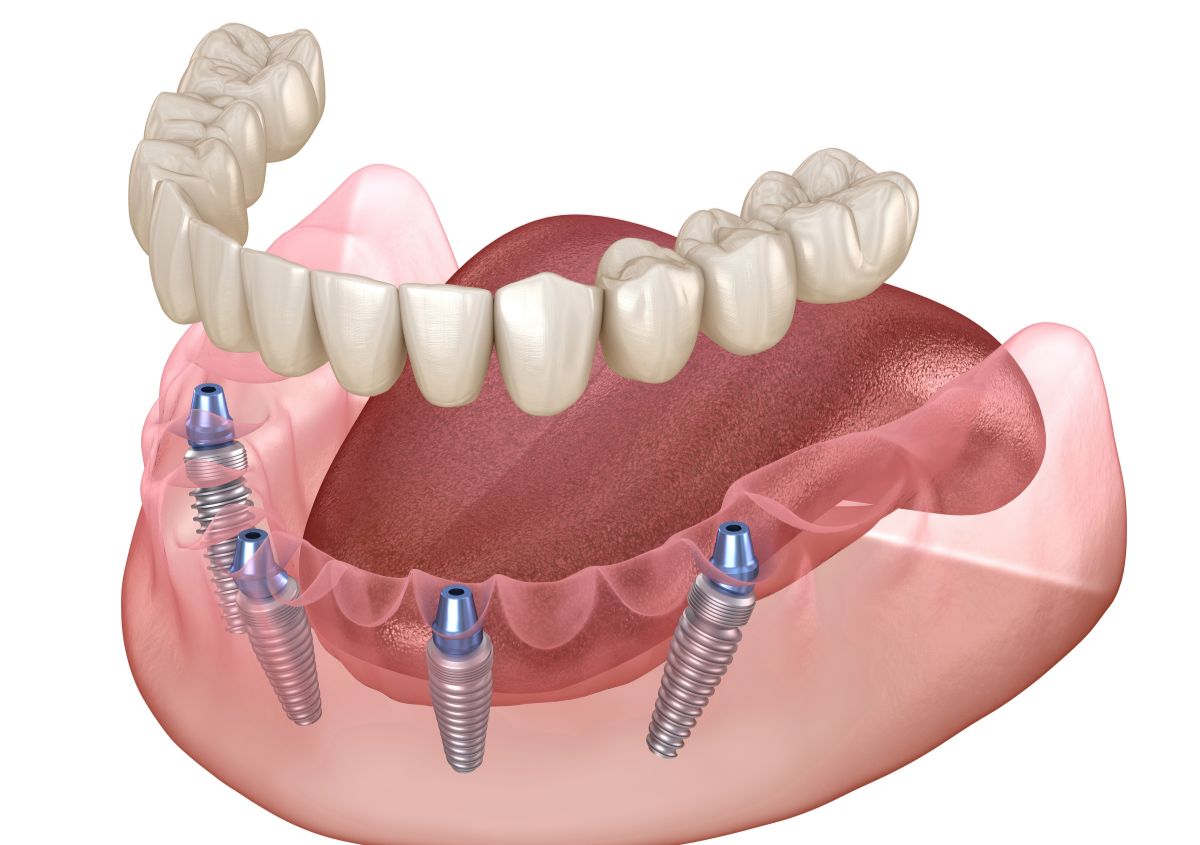
A dental implant is a titanium post placed surgically into the jawbone, where it integrates with the surrounding bone through a process called osseointegration. Once healed, a crown is attached to the top of the post, creating a tooth replacement that is anchored, stable, and functions like a natural tooth. The implant does not shift when eating. It does not require adhesive. It does not need to come out at night.
Dentures, by contrast, are removable appliances that rest on the gum tissue. Traditional complete dentures replace a full arch of missing teeth. Partial dentures use clasps attached to remaining natural teeth for stability when only some teeth are missing. Both can be fitted to look natural and function reasonably well for eating and speaking, but neither provides the same biting force or stability as an implant-supported replacement.
Bone Loss: The Long-Term Factor Most Patients Do Not Anticipate
When a tooth is lost, the jawbone beneath it begins to shrink. The bone in that area exists primarily to support the tooth root, and without that stimulation, it resorbs over time. This is not a slow or minor process. Research suggests that up to 25 percent of bone width in the extraction site can be lost within the first year, with continued gradual loss in the years that follow.
Dentures sit on top of the gum and do not engage the underlying bone. They do not stop or slow bone resorption. Over years of wearing a denture, the jaw continues to change shape, which is why dentures that fit well initially often become loose and uncomfortable a decade later. The facial changes that many longtime denture wearers experience, a sunken or aged appearance around the mouth, are largely the result of progressive bone loss that the denture could not prevent.
A dental implant stimulates the jawbone the same way a natural tooth root does, halting the resorption process. This is one of the most clinically significant advantages of implants that gets underemphasized in cost-centered discussions about the two options.
Cost: What Each Option Actually Costs Over Time
Dental implants have a higher upfront cost than dentures, and that difference is real. A single implant with the crown typically runs between $3,000 and $5,000 depending on the complexity of placement and any bone grafting that may be needed. Full-arch implant solutions, where implants support an entire set of replacement teeth, involve higher costs still. Traditional complete dentures are generally less expensive to start, often falling in the $1,000 to $3,000 range per arch depending on the materials and level of customization.
The longer-term cost picture is less straightforward. Dentures require relining and adjustments as the jawbone changes, and most dentures need to be replaced entirely every seven to ten years. A well-placed implant, by contrast, can last decades or a lifetime with routine dental care. The cumulative cost of denture maintenance and replacement over twenty to thirty years often narrows or eliminates the initial cost advantage.
Dental insurance coverage for implants is improving but remains limited at many plans. Dentures are more consistently covered, at least partially. Patients should review their specific plan details and ask the office about financing options before assuming either option is out of reach.
Comfort, Function, and Daily Life
Most patients who switch from dentures to implants describe the experience as transformative for eating. Dentures restore roughly 25 to 30 percent of natural biting force. Implants restore close to full biting force, which means patients can eat foods they had given up, including crunchy vegetables, nuts, and many proteins that require sustained chewing pressure. For patients in their 50s and 60s who are thinking about tooth replacement for the next several decades, that difference in daily quality of life adds up significantly.
Denture adhesive, the occasional loose fit, and the social self-consciousness that many denture wearers experience are real factors. They do not affect every patient equally, and some people adapt to dentures comfortably. But for patients who have tried a denture and found it frustrating, implant-supported options are often what changes the picture entirely.
Implant-Supported Dentures: A Middle Ground Worth Knowing About
For patients who need to replace a full arch but want better stability than a traditional denture provides, implant-supported dentures offer a practical middle option. Two to four implants are placed in the jaw and the denture snaps onto locator attachments anchored to those implants. The denture is still removable for cleaning, but it stays firmly in place during eating and speaking and does not require adhesive. The cost is lower than a fully fixed implant-supported bridge, and for many patients the stability improvement over a conventional denture is dramatic.
When Dentures Are Still the Right Answer
Implants are not appropriate for every patient, and a good evaluation will identify when they are not. Significant bone loss that cannot be corrected with grafting, uncontrolled diabetes, certain medications that affect bone healing, active periodontal disease, and heavy smoking can all affect implant success rates. Patients who are not surgical candidates for any reason, or who need an immediate solution while more extensive treatment is planned, may be better served by dentures in the near term.
Age alone is not a disqualifying factor. Healthy patients in their 70s and 80s receive implants successfully. What matters is the overall health picture, the bone available, and realistic expectations about the healing timeline.
Getting the Right Answer at All Smiles Dental in Burley
The implant vs. denture decision is not one that should be made based on a general article alone, because the right answer depends heavily on the individual patient’s bone density, medical history, number of missing teeth, and financial situation. Dr. Rice evaluates each patient with the specific information needed to make a genuine recommendation rather than a default one.
All Smiles Dental serves patients throughout Burley, Twin Falls, and the surrounding Magic Valley region. The practice is designed to make dental care approachable for patients who have put off treatment, whether because of cost concerns, past dental anxiety, or simply not knowing where to start. If you have missing teeth and are trying to decide which replacement option makes the most sense for your life, a consultation with Dr. Rice is the most direct path to a clear answer.
Call All Smiles Dental or schedule online to set up your consultation. Replacing missing teeth sooner rather than later protects the bone you still have and keeps more options available going forward.